
Planning
Backyard Basketball Court Guide: Half Court Sizes and Planning Tips
Thinking about a basketball court at home? Here are common half court sizes, regulation dimensions and the planning details that make a backyard court work.
6 min read
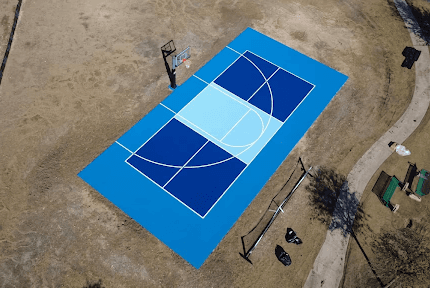
A backyard basketball court gives your family a place to play every day without driving to the gym. The first step is picking a size that fits your yard and the way you play.
Regulation half court dimensions
NBA and college half court: about 47 feet long by 50 feet wide
High school half court: about 42 feet long by 50 feet wide
Rim height: 10 feet
Free throw line: 15 feet from the face of the backboard
Lane (the key): 16 feet wide for NBA, 12 feet wide for high school and college
Three-point line: 19 feet 9 inches at the top for high school, longer for college and the NBA
Most homeowners do not need a full regulation half court. A smaller court still leaves plenty of room for shooting, drills and games.
Popular backyard court sizes
Shooting pad, around 20 x 20 feet: great for younger kids and shooting practice in tight spaces
Mid-size, around 30 x 30 feet: enough room for the key, free throws and one-on-one games
Large half court, around 30 x 50 feet or more: space for the three-point line and small-sided games
We size each court to fit the yard, so any of these can be adjusted.
Planning details that matter
Hoop placement. Leave room behind and beside the hoop so players are not running into fences, walls or landscaping.
Hoop type. In-ground hoops with adjustable height are popular because they grow with your kids.
Slope and drainage. Courts need a slight slope so water runs off. Uneven yards may need grading first.
Surface. An acrylic sport surface over concrete gives better grip and a cleaner look than bare concrete.
Fencing or ball containment. Helpful if the court sits near a pool, street or steep slope.
Lighting. Lights let you play after work and on summer evenings when it is cooler.
HOA and setback rules. Check neighborhood requirements before you build.
Add another sport to the same slab
Many families add pickleball lines to their basketball court so the space gets used even more. With smart line colors, both sports are easy to follow. See our multi-court options.
What affects the cost
Court size, site prep and grading, the hoop system, surface colors, lighting and fencing all affect the price. We give you a clear quote after looking at your property.
Ready to plan your court? Explore backyard basketball courts or request a free quote. For more size details, see our court dimensions guide.
We design, build, repair, resurface and clean pickleball, tennis, basketball and multi-sport courts for homes, schools and clubs across Dallas Fort Worth. Have a question about your court? Ask us for a free quote.
Planning
Court Surfaces Explained: Acrylic, Concrete, Asphalt and Tiles
What is a sport court actually made of? Here is how acrylic coatings, concrete and asphalt bases and modular tiles compare for outdoor courts in Texas.
6 min read
Planning
Tennis and Pickleball Court Lighting: A Homeowner's Guide
Court lighting lets you play after work and on cooler summer nights. Here is what to know about fixtures, placement, neighbors and local rules before you add lights.
5 min read

Planning
How to Choose Court Colors for Pickleball, Tennis and Basketball
Court colors affect how your court looks, how well you can see the ball and how hot the surface gets. Here is how to pick a combination you will love.
5 min read