
Repair
Pickleball Court Resurfacing: Process, Timing and What Affects Cost
Faded color, slick spots and new cracks mean your pickleball court is ready for resurfacing. Here is what the process involves, how often it is needed and what drives the price.
6 min read
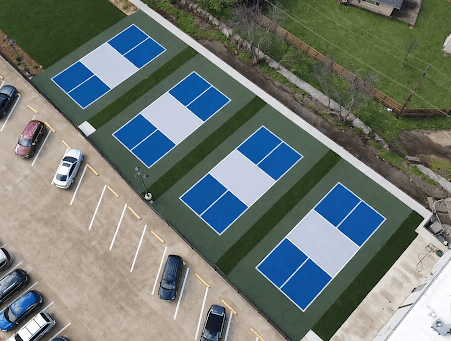
Pickleball courts take a beating from sun, weather and constant play. Resurfacing restores the color, grip and ball response that make a court fun to play on, and it protects the slab underneath. Here is what to expect.
How often does a pickleball court need resurfacing?
Most outdoor acrylic courts need resurfacing every 4 to 8 years. Courts in full sun, courts with heavy daily play and courts with drainage problems usually fall on the shorter end. In North Texas, intense summer heat and UV exposure speed up fading and wear.
Signs your court is ready
Color that looks faded, chalky or uneven
Slick areas where the texture has worn smooth
Hairline cracks or small surface cracks
Low spots that hold water after rain
Lines that are faded, chipped or hard to see
You want to change colors or add new lines
What the resurfacing process includes
Inspection. We check the slab, cracks and drainage to confirm resurfacing is the right fix.
Cleaning. The surface is cleaned of dirt, mildew and debris so new coatings bond properly.
Crack repair. Cracks are filled or treated with a crack repair system.
Low spot patching. Areas that hold water are patched and leveled.
Resurfacer coat. A base layer fills small surface imperfections and creates an even foundation.
Color coats. Textured acrylic color coats are applied for grip and consistent ball bounce.
Line painting. Lines are measured and painted to regulation dimensions.
How long does it take?
Most residential resurfacing projects take a few days of work, depending on court size, the amount of repair needed and the weather. Acrylic coatings need dry conditions and moderate temperatures to cure, so rain can push the schedule. The court also needs a short curing period before play.
What affects the cost
Court size and number of courts. More square footage means more material and labor.
Amount of crack repair. A few hairline cracks cost far less to address than widespread cracking.
Low spots and drainage issues. Patching and leveling add time and material.
Number of coats. Worn surfaces may need extra resurfacer or color coats.
Line layout. Adding blended lines for multiple sports adds layout and painting time.
Extras. New nets, posts, windscreens or fencing repairs add to the total.
Because every court is different, the best way to get an accurate number is an on-site inspection.
Resurfacing vs. rebuilding
If the slab has major structural cracks, heaving or widespread drainage problems, resurfacing may only be a short-term fix. Read our guide on resurfacing vs. rebuilding to learn the difference.
Ready to bring your court back to life? Learn about our repair and resurfacing services or request a free inspection.
We design, build, repair, resurface and clean pickleball, tennis, basketball and multi-sport courts for homes, schools and clubs across Dallas Fort Worth. Have a question about your court? Ask us for a free quote.

Repair
Tennis Court Crack Repair: Causes, Types and Fixes
Cracks are the most common problem on outdoor courts. Learn why they form, which cracks are minor and which need more attention, and how they are repaired.
5 min read
Repair
Court Resurfacing vs. Rebuild: Which Does Your Court Need?
Cracks, faded color and puddles often can be fixed without building a new court. Here is how to tell whether resurfacing will fix the problem or a full rebuild makes more sense.
5 min read