
Pickleball
Pickleball Court Layout Explained: Net Height, Kitchen and Lines
Here is a simple breakdown of a regulation pickleball court: net height, the kitchen, service areas and line markings, plus tips for building one at home.
5 min read
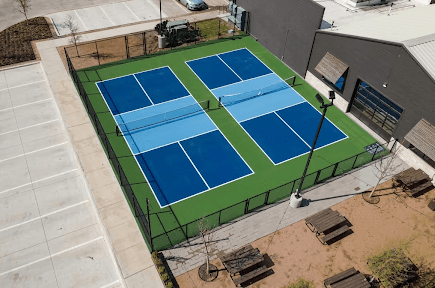
Whether you are building a court or just learning the game, it helps to know how a pickleball court is laid out. Here is a simple guide to every part of the court.
Court size
A regulation pickleball court is 20 feet wide by 44 feet long. The same size is used for singles and doubles. For comfortable play, plan for about 30 x 60 feet of total space, including room around the lines.
Net height
36 inches at the sidelines
34 inches at the center
The net sags slightly in the middle by design. Net posts are placed just outside the sidelines.
The kitchen (non-volley zone)
The kitchen is the area that extends 7 feet from the net on each side. Players cannot volley the ball, meaning hit it out of the air, while standing in the kitchen. Much of pickleball strategy revolves around play near the kitchen line.
Service courts
Behind the kitchen, each side is divided by a centerline into a right and left service court. Each service court is 10 feet wide and 15 feet deep, running from the kitchen line to the baseline.
The lines
Baselines: the lines at each end of the court
Sidelines: the lines along each side
Kitchen lines: the lines 7 feet from the net
Centerlines: the lines that split each service area in half
Lines are 2 inches wide and are part of the area they mark. They are usually white or another color that contrasts with the court surface.
Tips for a home pickleball court
Orientation. Running the court roughly north to south helps reduce sun glare.
Surface. A textured acrylic surface over concrete gives consistent bounce and good footing.
Fencing. Fencing or windscreens keep balls on the court and can help soften noise.
Permanent or portable net. Permanent nets are sturdier. Portable nets work well on shared courts.
Accurate layout. Lines should be measured and painted precisely so the court plays true.
Planning a pickleball court? Explore our pickleball courts or request a free quote. See our court dimensions guide for tennis and basketball sizes too.
We design, build, repair, resurface and clean pickleball, tennis, basketball and multi-sport courts for homes, schools and clubs across Dallas Fort Worth. Have a question about your court? Ask us for a free quote.
Pickleball
Pickleball vs. Tennis: Which Court Should You Build?
Pickleball or tennis? Compare space, playing style, who will use the court and noise to decide which court fits your home, HOA or club.
6 min read
Pickleball
Can You Add Pickleball Lines to a Tennis Court?
Yes, and it is one of the most popular court upgrades right now. Here is how adding pickleball lines works, how many courts fit and what to plan for.
4 min read